

AIM
The aim of the experiment is to measure the rate of decomposition of two different types of tea – green and rooibos. This information will be used to determine the health of the soil at your school, in your backyard or on your farm. Participants are provided with a TeaComposition ‘kit’ to conduct the experiment.
WHAT DOES THE KIT CONTAIN?
Your kit it will contain 10 x green tea bags, 10 x rooibos tea bags, seedling labels to mark where the tea bags are buried, a spade, wash bottle, soil sample jars, soil pH testing kit, trays, return post satchel, data sheets and lesson resources.
WHY DO WE USE TEA BAGS?
To determine whether the soil has a healthy microbial community that can decompose organic material, we need to provide them with something to decompose. Tea bags make excellent candidates because organic material is contained in the tea bag. This makes measuring differences in decomposition easy. In addition, the material of the tea bag allows air, water and microbes adequate access to the tea. In the TeaComposition project, we have followed a standardised methodology called the Tea Bag Index. In this methodology they use green tea bags and rooibos tea bags. A key difference between the two is that green tea breaks down easily while rooibos takes longer to decompose. The relationship between these two teas will tell us about the decomposition rate and stabilisation of the soil.
METHOD
1. Locating your two sites
At the beginning of September, you will bury your tea bags at 2 sites around your school – a managed (high human intervention) and an unmanaged site (natural, low human intervention).
2. Preparing your replicates
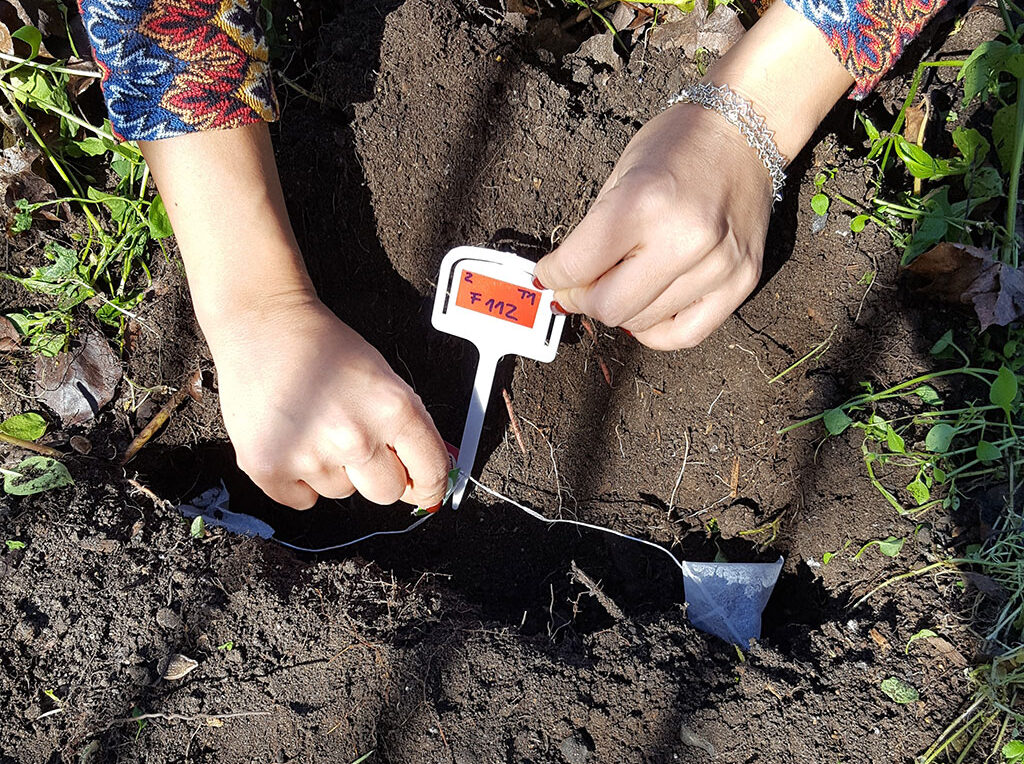
Each site will have 5 replicates where a replicate is defined by 1x green and 1x rooibos tea bag tied to a seedling label. It is important that each replicate remains intact, if one of the tea bags is damaged or goes missing, that replicate is no longer useful.
3. Weighing your tea bags before burial
Before you bury the tea bags at each site, they must all be weighed and the data entered on your school’s page. You will then bury your tea bags and leave them there for 3 months. If you start the project late, it is okay to bury the tea bags for 60 days.
4. Exhuming your tea bags
After 3 months you will exhume the tea bags and allow them to dry for a few days. You will then weigh the tea bags for their final weight and enter the data into your school’s page. If your final weights are greater than the initial weight, this could mean you need to allow the tea bags to dry for longer to evaporate any extra moisture.
5. Sending in your soil samples for analysis
You will also fill two containers (included in the kit) full to the top with soil from the managed and unmanaged site. Using the return post satchel, you will send them back to the University of Sydney and our soil scientists will analyse the soil for a particular set of properties that can inform us about soil health.
Useful links
Meet the team
TeaComposition is an outreach project from the Sydney Institute of Agriculture at the University of Sydney. The team involved is dedicated to investigating all things soil! You can learn more about the team below.
-

Professor Alex McBratney
ARC Laureate Fellow, Faculty of Science
Unlike the Nobel prize-winning poet Seamus Heaney in his famous poem ‘Digging’, I have been allowed to use the spade all my working life. Digging is my word for the study of the science of soil. I have been on a 40-year digging tour, a journey from a small part of rural Galloway in Scotland via England and Queensland and New South Wales to the whole world. I am thrilled that you have decided to join our ‘digging’ tour. The soil is perhaps the world’s greatest natural resource; a living skin that we all have to cherish and care for. Let’s dig together.
-
Professor Damien Field
Academic Director, Sydney Institute of Agriculture
I am fascinated by soil and how it provides so much for human and the planet’s health and wellbeing. As a soil scientist in the Sydney Institute of Agriculture I want to know how we can secure our soil for now and future generations. To do this, I focus on finding simple and easy ways to measure how capable soils are and their current condition. This means we can all be involved and my hope is that this will educate you about the importance of soil in our health and making sure they have some connection. This is why I am interested in the TeaComposition project. This easy to do experiment can tell us so much about the soil and its biological activity and enables you, the citizen scientist, to be involved in evaluating your soil.
-

Dr Edward Jones
Digital Soil Mapper
I love studying soil in the field and on the computer. Maps are a great way to display and share large amounts of information. At the Sydney Institute of Agriculture we make many different types of maps. Some show which areas of a paddock will yield more crop, others identify where you will produce the best tasting wine.
Now, with your help, we will make maps of the biological acitivity of soils. You may not notice it from above ground, but soils are incredibly diverse. Understanding this variation is important for understanding how the soil formed, how healthy it is and how we can secure our soils so that they can perform their important functions for humankind and the environment long into the future.
Good maps require a lot of data points so I am excited to work with all of you and build something great together. -

Dr Vanessa Pino
Soil Scientist
As a university student studying agriculture, I came to the realisation that the soil we walk upon is a largely unexplored world. This ignited my passion for soil and so I became a soil scientist. In my research I am investigating how soil ecosystems and how different components including plants and the organisms that live in the soil interact with one another.
Another passion of mine is citizen science as it can increase our knowledge by working together. The TeaComposition project is a great initiative that will bring together our local communities – from farmers to students and even researchers. It’s a lot of fun digging up tea bags from our gardens and environment. However, it’s also important because the information we receive could help to unlock the many secrets hidden in the soil and allow us to make changes for the benefit of the planet as a whole.
Interactive Soil Map
Our Soil Map Engineer has carefully incorporated the data obtained from the schools involved in the TeaComposition Project.